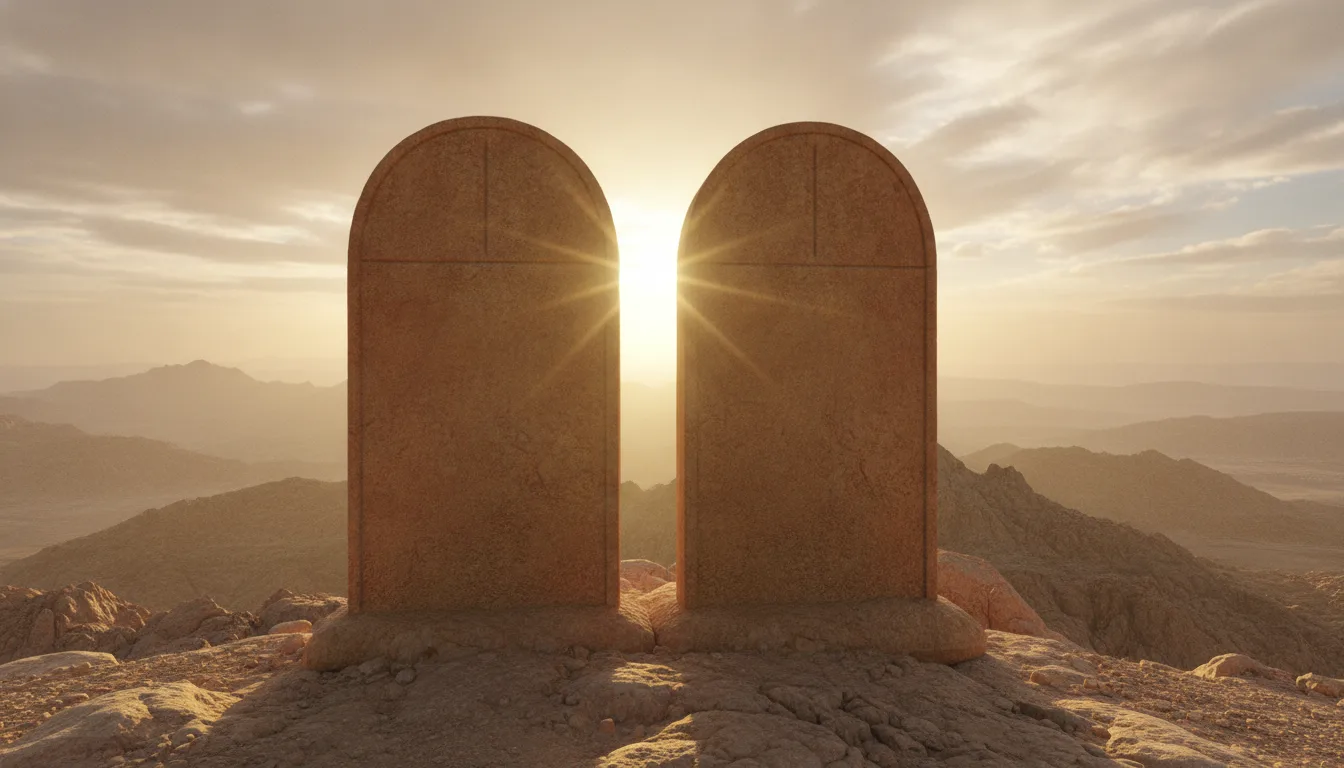
“Two tables of testimony, tables of stone, written with the finger of God.”Exodus 31:18 (KJV)
Written by God Himself
Most of the Bible was written by human authors under inspiration. The Ten Commandments are different. God spoke them aloud from Mount Sinai (Deuteronomy 4:12–13) and wrote them on two tables of stone “with the finger of God” (Exodus 31:18). That alone tells us how much they matter to Him.
The Ten Commandments (Exodus 20:3–17)
- Thou shalt have no other gods before me.
- Thou shalt not make unto thee any graven image… thou shalt not bow down thyself to them, nor serve them.
- Thou shalt not take the name of the Lord thy God in vain.
- Remember the sabbath day, to keep it holy… the seventh day is the sabbath of the Lord thy God.
- Honour thy father and thy mother.
- Thou shalt not kill.
- Thou shalt not commit adultery.
- Thou shalt not steal.
- Thou shalt not bear false witness against thy neighbour.
- Thou shalt not covet.
Read the full wording in Exodus 20:1–17. The second and fourth commandments are longer than many printed versions show, and it's worth reading them in full.
A law of love
Jesus summed up the commandments in two great principles: love God with all your heart, and love your neighbour as yourself (Matthew 22:37–40). The first four commandments show how to love God; the last six show how to love people. Paul wrote, “love is the fulfilling of the law” (Romans 13:10).
Seen this way, the commandments are not a cage but a description of a free, healthy, loving life, the kind of life God's own character reflects.
Do they still apply today?
Jesus said plainly, “Think not that I am come to destroy the law… Till heaven and earth pass, one jot or one tittle shall in no wise pass from the law” (Matthew 5:17–18). Paul asked, “Do we then make void the law through faith? God forbid: yea, we establish the law” (Romans 3:31).
We are not saved by keeping the law. We are saved by grace. But grace gives us the desire and power to keep it. “For this is the love of God, that we keep his commandments: and his commandments are not grievous” (1 John 5:3).
Questions for reflection
- Read Exodus 20:1–17. Which commandment do you think is most overlooked today?
- How do the two great commandments (Matthew 22:37–40) summarize all ten?
- What does Matthew 5:17–19 tell us about Jesus' view of the law?
- How do grace and obedience work together (Romans 3:31; 1 John 5:3)?